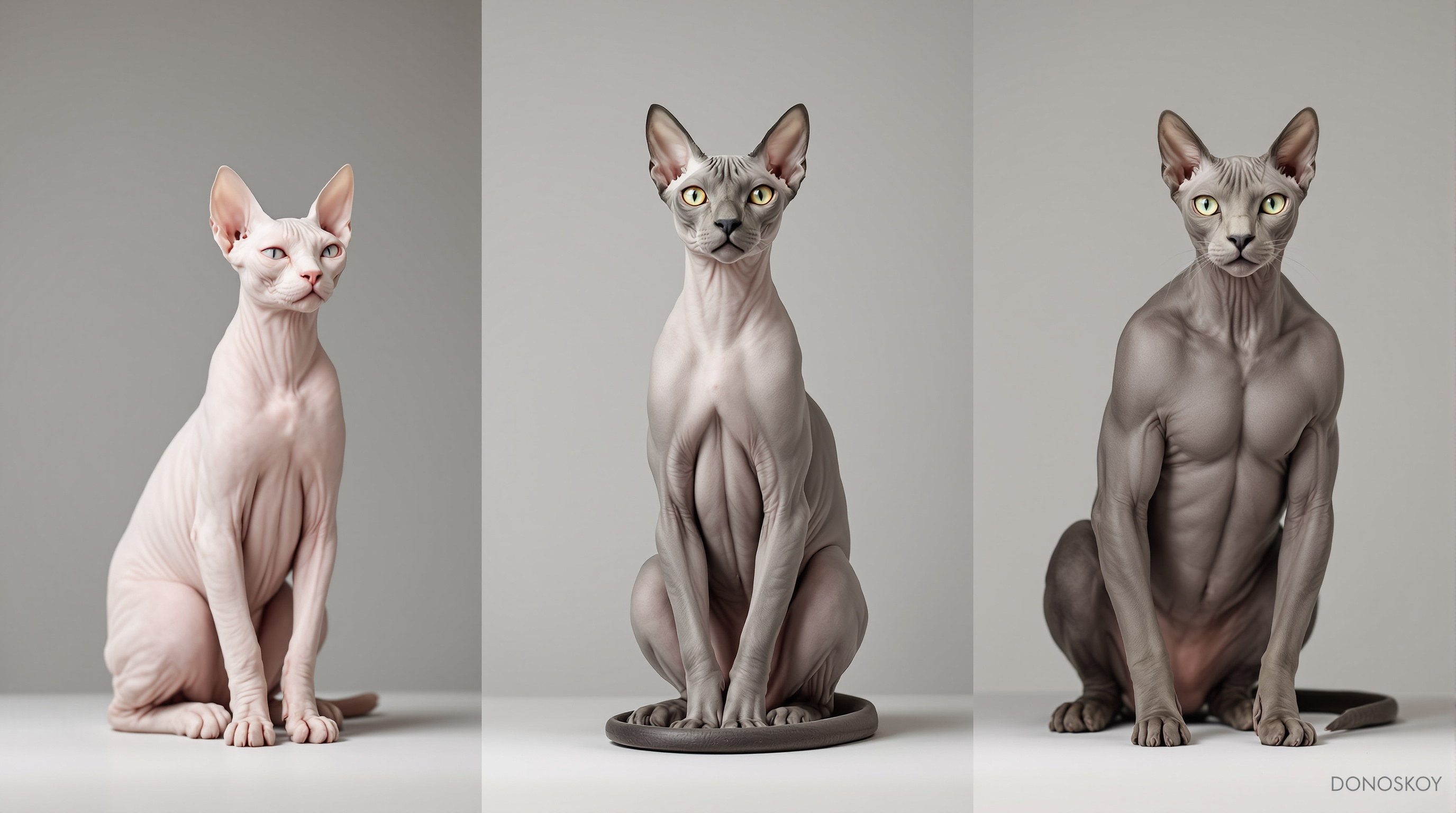
The world of hairless cats extends far beyond the well-known Sphynx. These unique felines come in various breeds, each with distinct characteristics, personalities, and care requirements.
The Sphynx is undoubtedly the most recognizable hairless breed, originating in Canada in the 1960s. These cats are characterized by their wrinkled skin, prominent cheekbones, and large, lemon-shaped eyes. Despite their alien-like appearance, Sphynx cats are incredibly warm to the touch, with skin that feels like a heated chamois leather.
Personality-wise, Sphynx cats are extroverted entertainers. They're highly intelligent, energetic, and crave human attention. These cats are known for their acrobatic abilities and clown-like antics. They're excellent with children and other pets, making them ideal family companions. Their social nature means they don't do well when left alone for long periods.
Originating in Russia in the 1990s, the Peterbald resulted from crossing a Donskoy with an Oriental Shorthair. These elegant cats have a distinctive oriental body type – long, lean, and graceful with a wedge-shaped head and large, flared ears. Peterbalds can actually have varying degrees of hairlessness, from completely bald to a fine velour coat.
Peterbalds are known for their sweet, affectionate nature and high intelligence. They're active cats that enjoy climbing and playing, but they're also content to curl up in a warm lap. Their vocal nature means they'll often 'talk' to their owners, expressing their opinions on everything from dinner time to the weather.
Also known as the Don Sphynx, this Russian breed is distinguished by its muscular build and unique webbed toes. Unlike the Sphynx, whose hairlessness is caused by a recessive gene, the Donskoy's baldness comes from a dominant gene. This means breeding is somewhat different, and the cats can be born with fur that they lose as they mature.
Donskoys are intelligent, friendly, and easy-going cats. They're less demanding than Sphynx cats but equally affectionate. Their calm temperament makes them excellent therapy animals, and they adapt well to various living situations.
A cross between a Sphynx and a Munchkin, the Bambino combines hairlessness with short legs. These small cats maintain the Sphynx's playful personality in a compact package. Despite their short stature, Bambinos are surprisingly agile and energetic.
This unique breed features not only hairlessness but also distinctive folded ears, resulting from crosses between Donskoy and Scottish Fold cats. The Ukrainian Levkoy has a dog-like face with angular contours and a muscular body. They're known for being sociable, playful, and intelligent.
A newer breed created by crossing American Curls with Sphynx cats, Elf cats feature the hairless body of a Sphynx with distinctive curled ears. They inherit the best traits of both parent breeds – the Sphynx's outgoing personality and the American Curl's gentle nature.
Combining traits from the Sphynx, Munchkin, and American Curl, the Dwelf is hairless, short-legged, and has curled ears. These rare cats are playful, affectionate, and require the same intensive care as other hairless breeds.
When choosing a hairless breed, consider factors beyond appearance. Each breed has specific care requirements, activity levels, and health considerations. The International Cat Association (TICA) provides detailed breed standards and information for prospective owners.
Additionally, connecting with breed-specific rescue organizations can provide valuable insights into each breed's temperament and needs. Remember that hairless cats, regardless of breed, require dedicated care including regular bathing, sun protection, and climate control.
Their unique needs are offset by their extraordinary personalities and the deep bonds they form with their human families. Whether you choose a playful Sphynx, an elegant Peterbald, or a calm Donskoy, you're sure to find a devoted and entertaining companion.