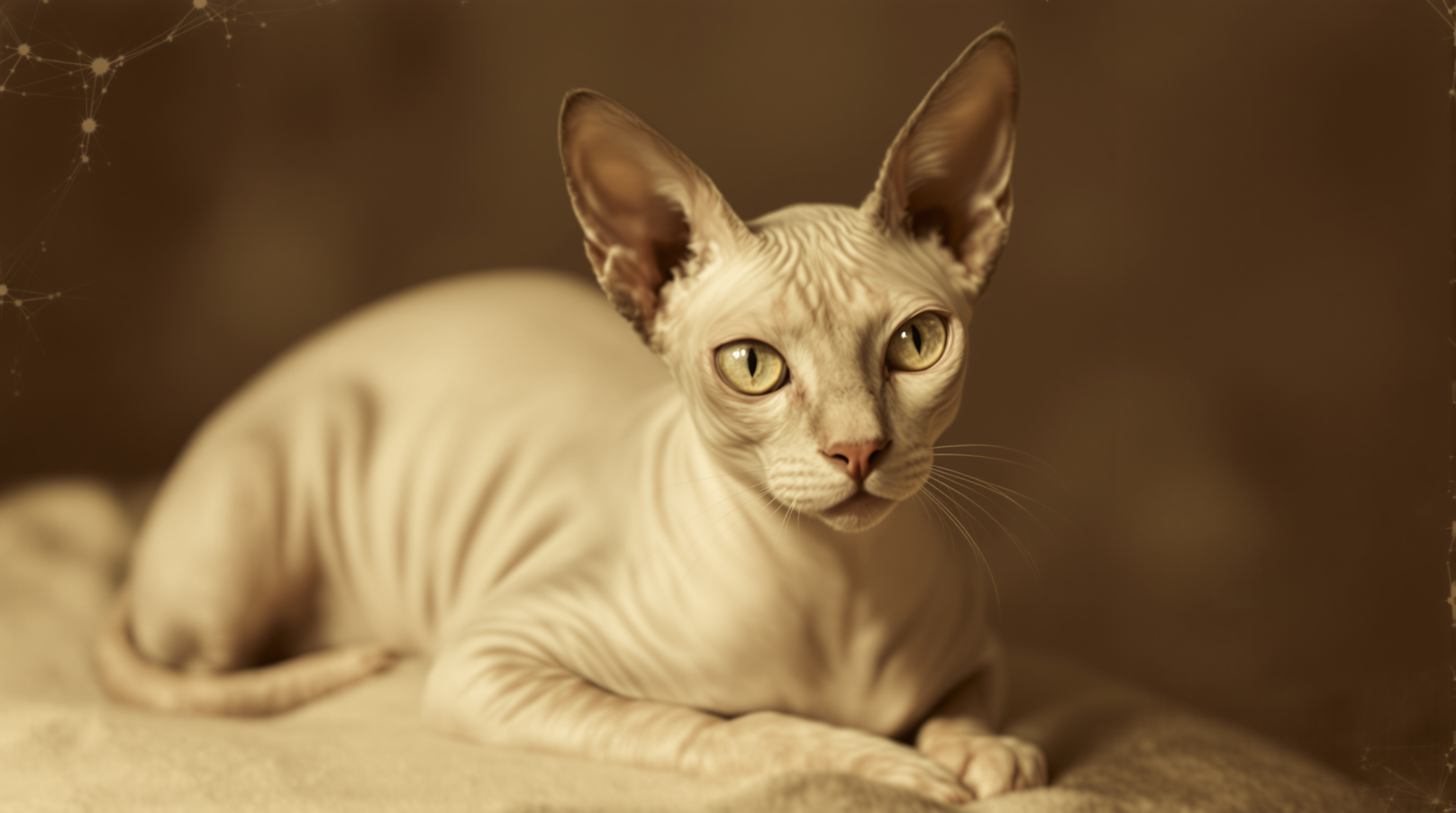
From ancient mutations to modern breeds - the fascinating journey of hairless felines through history.
Hairless cats have captivated humans for centuries with their unique appearance. While they may seem like a modern phenomenon, hairless cats have appeared naturally throughout history in various parts of the world. The development of recognized hairless breeds, however, is a relatively recent achievement in cat breeding.
Hairless cats are not a new occurrence. Natural genetic mutations causing hairlessness have been documented throughout history:
These early hairless cats typically died without reproducing or were not selectively bred, so the trait didn't establish ongoing lines.
The modern Sphynx breed traces its origins to 1966 in Toronto, Canada, when a domestic cat gave birth to a hairless kitten named Prune due to a natural genetic mutation.
Prune was bred with his mother (backcrossing) to produce more hairless kittens. This early Canadian line helped establish hairlessness as a reproducible trait, though the line eventually died out due to genetic issues and difficulties maintaining the breed.
A separate hairless mutation appeared in a Minnesota barn cat named Epidermis, followed by another named Dermis. These cats were bred with Devon Rex cats to strengthen the gene pool and improve health.
Three hairless strays - Bambi, Punkie, and Paloma - were found on the streets of Toronto and sent to a Dutch breeder. These cats became crucial to establishing the European Sphynx lines.
The journey to official breed recognition was long and challenging:
Today, the Sphynx is recognized by all major cat registries worldwide, including TICA, CFA, and international organizations.
Russia has contributed several unique hairless breeds to the cat world:
In 1987, cat breeder Elena Kovaleva discovered a hairless kitten named Varvara in Rostov-on-Don, Russia. Unlike the Canadian Sphynx's recessive gene, the Donskoy carries a dominant hairless gene. This breed was officially recognized by WCF in 1997.
Created in 1994 in St. Petersburg by crossing a Donskoy with an Oriental Shorthair, the Peterbald combined hairlessness with the elegant oriental body type. The breed was recognized by the Russian Selectional Feline Federation in 1996.
Understanding the genetic basis helps explain why different hairless breeds exist:
Caused by a recessive mutation in the KRT71 gene. Both parents must carry the gene for hairless offspring. Cats can carry the gene while appearing fully furred.
A dominant mutation means only one parent needs to carry the gene. However, two copies can be lethal, so careful breeding is required.
In recent decades, breeders have created new hairless varieties by combining existing breeds:
These newer breeds are often considered experimental and may not be recognized by all registries.
Hairless cats have made their mark in popular culture:
Their unique appearance has transformed from being considered "ugly" to being celebrated as exotic and elegant.
From rare natural mutations to beloved companion animals, hairless cats have come a long way. Today's carefully bred hairless cats are healthier and more genetically diverse than ever, thanks to decades of dedicated breeding programs. What started as a genetic curiosity has become a family of recognized breeds cherished by cat lovers worldwide.